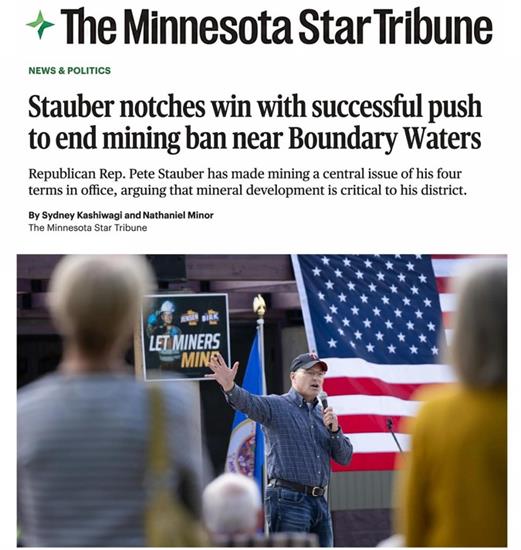
This legislation ends years of this issue being used as a political football. For over a decade, Democrat administrations repeatedly imposed mining bans on this land, only for Republican administrations to reverse the action, leaving proposed projects in perpetual limbo.
My bill provides a durable solution. It ensures that no future Democrat administration can unilaterally lock up this vital land from responsible mineral development. It restores Minnesota’s authority to review responsible mining projects through the rigorous state and federal environmental permitting process.
Minnesota’s union miners are now one step closer to developing our vast domestic deposits of copper, nickel, cobalt, and platinum group metals that we urgently need here at home to reduce America’s dangerous reliance on the Chinese Communist Party.
We are one step closer to bringing good-paying union jobs and economic prosperity back to Minnesota’s mighty Iron Range for generations.
Mining is our past, our present, and our future – and the future looks bright!
Mining Myth vs. Fact
There has been considerable misinformation from anti-mining groups and the media about this bill, so I want to set the record straight:
- MYTH: This bill will automatically allow mining to move forward.
Fact: This bill does NOT greenlight any specific mine or project. It simply restores Minnesota’s authority to evaluate proposals through our established, rigorous state and federal permitting process.
- MYTH: This bill will allow mining inside the Boundary Waters Canoe Area.
Fact: There will be NO mining in the Boundary Waters and its surrounding buffer zone. Mining is already prohibited there, and Minnesota law forbids any activity that would degrade the BWCA’s water quality.
- MYTH: The type of mining that is being proposed can not be done safely.
Fact: Modern underground copper-nickel projects can meet Minnesota’s toughest-in-the-nation water standards, and the proposed mining projects can do that as they have been carefully planning for years on how to sustainably mine metals in the region. There are already similar mines in North America that have been operating without any damage to the environment. For example, Michigan’s Eagle Mine, a copper-nickel operation, has run without issue since 2014. There is also the Rainy River Mine in Stratton, Ontario, which has been operating safely in the Rainy River Watershed since 2017, which is the same watershed where projects in Minnesota are proposed.
- MYTH: This bill only benefits a Chilean mining company that plans to send its minerals to China.
Fact: This bill is not about one specific project or company. It’s about restoring a process that would allow for fair consideration of projects interested in having Minnesotan miners responsibly producing copper, nickel, cobalt, and platinum groups right here in America by going through state and federal environmental reviews to determine whether they can meet our strict standards. The most effective way to keep minerals out of China’s control is to produce and process them here in the United States. Some groups opposed to one of the proposed projects, Twin Metals, are pointing fingers at their Chilean ownership, even though the people who work at Twin Metals are Minnesotans who live in the area and care deeply about protecting the environment while advancing opportunities for their communities. Additionally, current proposed projects in the Superior National Forest are expected to generate $3 billion in funding for the Permanent School Fund (PSF) and nearly $750 million in state and federal taxes and royalties.
Tax Day Means Bigger Tax Refunds
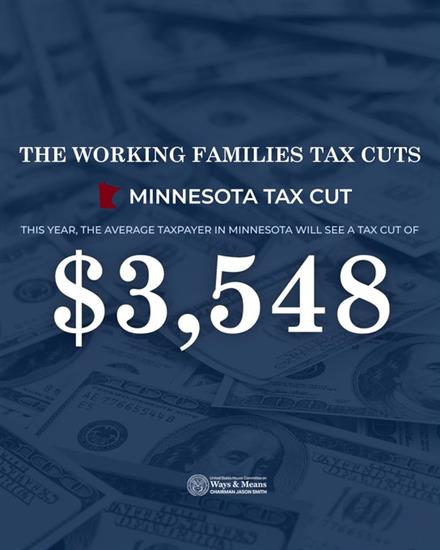
In addition to mining, I have more great news to share. April 15th was Tax Day, and thanks to the Working Families Tax Cuts Act, which Congress passed with my support, and President Trump signed into law last year, Americans are seeing higher refunds this year.
In fact, refunds are up 11 percent with the average taxpayer in our state saving $3,548 this tax season.